Movement challenges and drawing puzzles
Two useful examples show how far apart stickman games can be. Stickboys Hook asks you to swing and jump toward a finish line, while Stickman Rescue Draw 2 Save asks you to protect a character by drawing something that helps. One rewards decisions made during movement; the other rewards a design that survives the danger in a particular scene. Try the style that matches whether you want to react or plan.
The collection also includes cards such as Stickman Team Return, Prison Escape Online and Stickman Rope Heroes. Read their individual pages before assuming they use the same controls or objectives. The shared character style is useful for browsing, but it does not promise a shared combat system, a multiplayer mode or a particular set of keyboard commands.
Stickboys Hook: think about the next connection
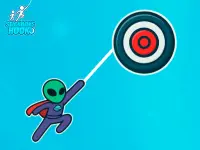
Stickboys Hook combines launch ramps and rope swings across twenty levels. Click or tap to rope, and use the available connections to work toward the goal. Falling out of the course ends the attempt. The important question is where the character will travel after the current movement, rather than whether a connection is available right now.
During an early attempt, watch how a swing changes the direction of travel. A connection that keeps you above a gap can still leave an awkward approach to the next part of the course. After a fall, identify the last point at which you still had a useful choice. Changing that decision gives you a clearer experiment than repeating every input faster. Follow the loaded game's own prompts for any additional actions.
Stickman Rescue Draw 2 Save: give each line a job
In Stickman Rescue Draw 2 Save, a shield, bridge or another helpful shape can protect a character from a dangerous situation. Scenes can involve falling rocks, flying arrows or a gap. Before drawing, locate the character and decide where the danger will reach. A shield needs to block an approach; a bridge needs to support a crossing. A complicated drawing is not automatically better at either job.
Keep the first design simple enough to understand when it fails. If something slips past a barrier, examine the opening instead of adding detail everywhere. If a crossing offers poor support, reconsider where its useful surface belongs. Adjusting one feature at a time helps separate a promising idea from a misplaced line. The goal is a dependable rescue for the current scene, rather than a single shape to copy across every puzzle.
Choose another session by what you enjoyed
If drawing and reasoning appeal to you, the Puzzle games collection offers another route into problems where a deliberate choice matters. If you prefer immediate movement challenges, browse the Arcade games collection. These collections are broader than stickman games, so use them when the mechanic matters more than the character's appearance.
For each new game, take a moment to find the objective and the instructions before trying to optimize a run. Work out what counts as failure and what action you can change. A missed swing, a weak barrier and an incorrect escape choice call for different corrections. Describing the mistake precisely makes the next attempt more useful than a general instruction to improve your reflexes.
Controls depend on the selected game
Mouse, touch and keyboard support vary between titles. Stickboys Hook explicitly supports clicking or tapping, while the rescue game uses drawing input. Check the game's own controls on the device you plan to use. Start with a short attempt to learn how input affects the scene, then choose whether you want to continue that challenge or return to the collection for another kind of stickman game.