Wait for a usable crossing
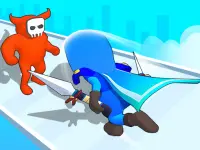
In the site catalogue, Hero vs Traps gives you a character to guide around moving saws. Hold and drag to move, and release to stop. Start by reading the stage condition. A route that takes you quickly to the exit may be irrelevant if the stage asks you to collect chests, activate objects or survive until the timer ends. Choose the crossing that advances the current task.
When waiting near a saw, look at the far side of the route. It is possible to start in an opening and still have nowhere to stop once you reach the next section. Decide where you can pause, then watch whether the moving object will leave that place accessible when you get there. If you cannot see a useful exit, let the movement repeat before committing.
Build enough height for the next object
Stacky Bird uses a chain of eggs to help the bird pass obstacles. Follow its opening prompts and match each action to the next visible obstruction. Check both the lower boundary and what may be above the route, including monsters or spikes. A stack that cleared one obstacle may not be the one you want for the next section. Watch the response to your input before adding more.
When you run into trouble, identify whether you changed the height too late or whether you were responding to the wrong obstacle. That distinction can save an entire series of retries. A clear correction starts with a visible problem: the next opening was higher than expected, or the bird was already between hazards when you tried to change the stack.
Read the obstacle in relation to your own movement
The collection shows several kinds of routes, including car descents, parkour and adventures. Their obstacles might be stationary, moving, or only difficult because they restrict where you can land. Start by identifying what can change before you arrive. A moving saw can make waiting useful. A tight landing may be easier to handle by correcting your direction long before you reach it.
Inspect a complete movement after you make it. If it works, check where it leaves you and whether that position is useful for the next obstacle. If it fails, think back to the first moment when you lost room to make a choice. You may need an earlier change rather than a faster reaction at the point where the accident occurred.
Pick a first route to learn
Browse Arcade games for quick movement challenges with other objectives. Within this collection, check how a game lets you respond to the obstacle. Does it ask you to wait, jump, drag or steer? Try the simplest movement the interface demonstrates before using it in a tight place. After the attempt, describe which section still has an uncertain exit. Learning where you will stop or land gives the next input a clear purpose instead of simply carrying you toward a hazard.
When switching games, notice the first place where the route stops being straightforward. Use that spot to test how long an action lasts and what happens when you release it. Learn the response on a clear approach before trying the same input beside a hazard.