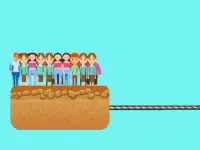
Use timing to reach a specific outcome
Cut the Rope is a related skill puzzle in which a suspended candy needs to reach Om Nom. Before cutting, look at which rope supports the candy and what can happen when the support changes. Keep the last support in mind. A cut can give you a swing or a drop, and the next decision depends on the movement that is already underway.
On a retry, choose a specific landmark to watch. If the candy consistently falls beside the mouth, check whether it was still moving sideways at the final release. If it never reached a star you intended to collect, inspect the earlier part of the route. A change that improves the final drop may not fix an opening swing that goes to the wrong place.
Use comparison when the task is creative
The collection also displays Eye Color DIY. Its activity is about changing the appearance of an eye design with colour and effects. The skill is different: make one change, inspect the result and decide what you want to keep or adjust next. Applying several effects at once can make it difficult to identify which choice produced a contrast you liked.
Choose a plain starting arrangement if the game offers enough choice to do so. It is easier to see what a colour or tool changed when the area was easy to read beforehand. If the result differs from what you intended, check whether the input affected the right position. Then decide whether you need a different colour or a more controlled application.
Pick a practice question for a new card
Other cards on the collection page suggest rope puzzles, racing, boxing and ball-control games. The shared tag does not tell you whether the controls are timing based or whether a level waits for you to decide. Read the game instructions and try an uncomplicated input. Then identify what the response tells you: what moved, which action registered, and which part of the objective it advanced.
When you find a move you can repeat, use it to make a fair comparison. Keep the starting conditions similar and change one part of the input. A later change in direction may matter in a movement game. In a design task, changing only the colour can be more informative than choosing both a new shade and a new tool. Use the experiment that fits the goal.
Read success before measuring speed
Try the Puzzle category if you want choices where the result is easier to inspect after each move. A practiced action is useful when you know what it accomplished. In Cut the Rope that may mean delivering the candy along the route you intended. In a design game it may mean making a visible change you can reproduce. Use that result to choose the next skill to practise. Speed becomes useful when the action already has a clear purpose and you can see whether it worked.
If a change helps once, repeat it from a similar position before adding another variable. A result you can reproduce is easier to carry into a difficult part of the game than a good outcome whose cause you did not see.