Check the colour and plan the return trip
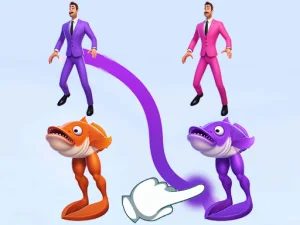
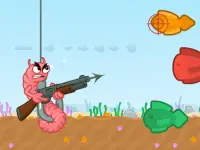
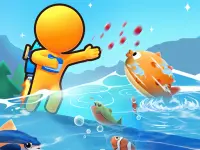
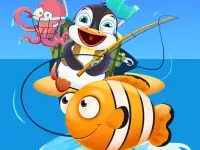
Home Rush The Fish Fight asks you to guide a human character toward a fish it can defeat. The human and fish must have the same colour. Avoid obstacles and opponents along the approach, then return to the starting point. The journey has an outward and a return part, so reaching the fish alone does not describe the whole objective.
Identify the pair before moving. A route toward the wrong colour cannot be fixed simply by making the movement cleaner. Once you have chosen the intended fish, inspect the space between it and your character and think about the way home. This separates target selection from the practical problem of getting there.
The provider describes dragging and holding to guide movement, with mouse click or tap listed as input. Follow the current game prompts rather than assuming keyboard combat controls. On an early attempt, watch how the character follows the gesture and where an obstacle first interferes with the plan.
If the attempt fails, check the colour condition before redrawing or repeating the approach. Then identify the first point where the actual route diverged from the intended one. A correction to that point gives you more useful feedback than changing the pairing, path and pace together without knowing which was wrong.
Balance feeding with room to avoid danger
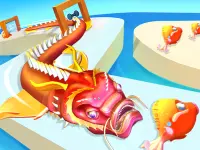
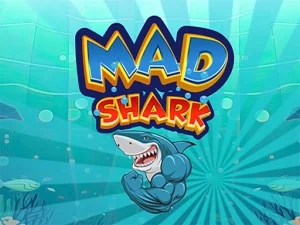
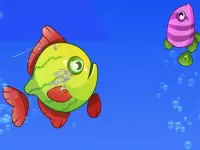
Fat Shark makes eating a trade-off. Fish feed the shark, but a growing body becomes harder to keep away from bombs. Collecting more food therefore changes the movement problem. The route that seemed comfortable earlier may leave too little clearance after growth.
Look at the whole shark when judging a passage. A clear space for its head does not necessarily provide room for its body or the next turn. Before moving toward a fish, inspect the surrounding bombs and the direction you could take afterward. Food close to danger deserves a different approach from food in open water.
The listed controls use mouse clicks or touch. Learn the response in a less crowded section and make a deliberate correction before trying a narrow route. A movement scheme from another underwater game is not a reliable guide to this version's input.
Use the theme to compare different decisions
The two examples reward different kinds of attention. Home Rush begins with matching a human to a fish and planning a complete journey. Fat Shark keeps changing the clearance available as the shark eats. One asks whether the target and route satisfy the level; the other asks whether the next meal still leaves a safe path.
After a collision or failed route, remember the position just before the problem became unavoidable. Did the chosen destination make the trip unsuitable, did an obstacle block the planned line, or did growth remove the turning space? Use that answer to choose a single adjustment for the next attempt.
Pick another short challenge
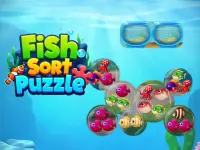
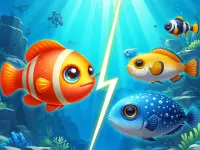
The completed Arcade category offers other immediate movement and timing tasks. Return to the fish collection when you want an aquatic theme, but check the selected game's own objective, controls and completion feedback before treating it as the same kind of challenge as the previous card. Give an unfamiliar input a clear test: choose a small movement, observe the response and only then combine it with a more demanding route.