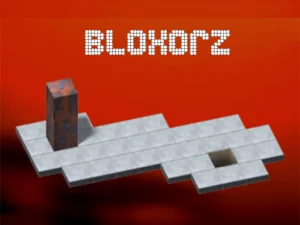
What the current game asks you to solve
In the hosted Bloxorz game, the block may stand upright on a single tile or lie across two tiles along a row or column. Those states have different movement possibilities. A move toward a narrow passage can be safe in one orientation and impossible in another. The distributor identifies this version as a 33-level puzzle and lists WASD or arrow-key movement.
The collection is currently narrow rather than a large assortment of unrelated versions. If more cards are added later, read their own descriptions and controls before assuming that level layouts or mechanisms are interchangeable. A familiar title or block shape does not establish that a walkthrough's sequence belongs to the game you have opened.
Plan the footprint of the next move
Look at every tile the block will occupy after a roll. An upright block tipping over needs support for its longer footprint. A flat block rolling along its length behaves differently from one rolling sideways. Watching only its center can hide the fact that one end will extend over empty space. Use an open area to learn these transitions before attempting an edge crossing.
Record a position with its orientation: upright at the bridge entrance is a useful checkpoint, while near the bridge is incomplete. When a route repeatedly fails, compare the actual state with the intended checkpoint. The wrong alignment can originate several moves before the place where the block finally falls.
Work back from the finish
Examine the square hole and ask which final roll would place the block upright above it. That reveals a small set of useful approach states. Plan toward one of those states instead of moving vaguely toward the exit. Continue backward until you identify a wider platform where the required orientation can be prepared safely.
This approach also explains why loops can be productive. A short circuit around a broad area may change the block's alignment or offset without bringing it closer to the hole. Distance has not improved, but the available next moves have. Once a valid solution is established, you can decide whether any extra rolls are unnecessary.
Keep track of the board as well as the block
Switches and special tiles can change which routes are available. Read the game's explanation when a mechanism appears and observe the resulting bridge or passage. A route note should include relevant switch states, because the same block position can lead to a different result when the board has changed.
When a mechanism separates the block, the listed Space control switches between pieces. Confirm which piece is active, place it deliberately and then consider the other piece's route. Do not assume both pieces need the same path. The important goal is a configuration that permits reunion and a useful onward orientation.
Choose a suitable setup and pace
A keyboard is the clearest supported starting point for this build. Its distributor marks it as not mobile ready, so equivalent touch-only controls are not guaranteed. Use single key presses when learning a narrow route. Holding a direction can add an unintended roll and discard a carefully prepared state.
The Bloxorz planning guide develops the footprint method, backward reasoning and checkpoint notes in more detail. After a failed attempt, identify one mistaken assumption before restarting. Learning that an approach cannot produce the needed orientation is useful progress, even before you complete the board.
For a short session, practice one skill at a time: entering a corridor correctly, predicting a tipping footprint or leaving a switch in a useful state. This keeps experimentation purposeful and makes the next attempt build on the previous one.