















volleyball random: Your chaotic, couch-co-op volley fix
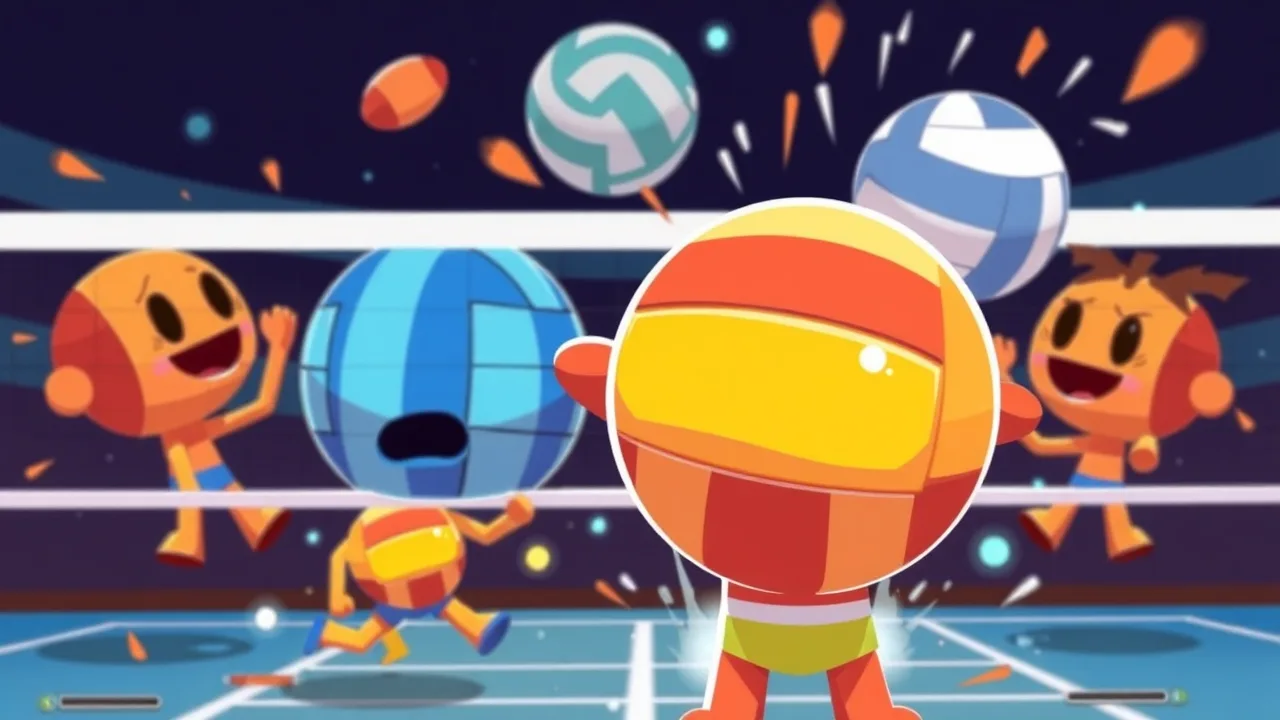
If you want a quick, messy, highly replayable sports brawl you can share with a friend on one keyboard, volleyball random is the move. It’s the volleyball entry in the “Random” series, built around one-button controls, ragdoll chaos, and rounds that end before your pizza gets cold. You can play solo versus CPU or 2-player locally, with the match usually going to 5 points and the arena, ball, and even your tiny athletes remixing every round.
To jump straight into a browser version, here’s the page you’ll want: Play Volley Random. Keep this tab handy; I’ll reference techniques you can try there.
🎮 What you actually do in this one-button chaos
You and your opponent each control a duo of wobbly volleyballers. Tap one key to make them hop, time it well to meet the ball, and try to send it over the net so it hits the ground on the other side. That’s it on paper but in practice your timing, angles, and patience are constantly tested, because physics is unbothered by your plans. Courts, balls, and character sizes rotate in at random, so you’re forever adjusting. Matches are short, the score target is low, and new rounds load instantly, which keeps the loop addicting for quick duels.
If you’re new to volleyball rules in general, skimming the basics helps. The idea of rally scoring, serve-receive, and out-of-bounds carry over conceptually, even when a giant beach ball shows up. A quick primer is here: Volleyball on Wikipedia.
🧪 The Random series DNA (and why it works)
Volley Random comes from the same studio and vibe as Soccer Random and Basket Random: a light arcade take with the “one button, two ragdolls” control scheme, weird arenas, and comedic failure that’s still skillful once mastered. That mix matters. The randomness lowers the barrier to entry you can win a point with luck but consistent winners are the players who learn to read bounce arcs, anticipate the next hop, and buffer inputs at the right rhythm. Developer notes point to the ragdoll physics and constant variation as intentional hooks, not gimmicks.
⌨️ Controls and setups that actually feel good
-
Keyboard defaults: Player 1 uses W; Player 2 uses Up Arrow. On touch devices, you tap. That’s literally it, and yes, this minimalism is the point.
-
Local couch rules: The game shines in the 2-player mode on one keyboard. Sit side by side, agree on best-of-5 matches, and keep a paper tally. First to five points per game is standard; run a first-to-three series if you want a longer set.
-
Browser vs mobile: It runs in browser and also has mobile ports. If you’re on a phone or tablet, tap timing is trickier because you lose key travel feedback. On desktop, the keyboard click gives rhythm cues you can learn faster.
🏗️ Skill in a “random” game: what separates winners
1) Own the apex. Treat every hop like setting yourself under the ball’s highest point. Your ragdolls don’t turn on a dime, so jump early, land where the ball will be, then hop again to meet it at peak height. Higher contact equals cleaner send.
2) Buffer taps in micro-bursts. Instead of mashing nonstop, think in tap-pause-tap patterns. The physics engine reacts to when you leave the ground; two quick hops often beats a single panic jump because you can adjust mid-trajectory.
3) Read the spin and surface. Different balls bounce differently. When the round rolls in a heavier ball, lower your contact point and accept a shorter arc. On super bouncy balls, pop it upward first, then attack on the second jump.
4) Zone defense > hero plays. Since two characters move together, anchor your “front” ragdoll on the near-net line and keep the partner a half-screen back as insurance. Think blocker plus libero. On returns, swap roles naturally by who touches first.
5) Aim for awkward landings. Forget line painting. Send medium-height shots that force the other team to land mid-court, then immediately drop a soft touch just over the tape. They’ll whiff because their follow-up jump comes too early.
6) Manage the serve. If you control the initial contact, launch a high, center-line lob and chase beneath it. You’ll reach the ball first, turning serves into self-sets.
7) Tilt the chaos in your favor. When a new court variant appears snow, sand, mini players take the first rally to test jump height and bounce distance. Your opponent will still be guessing on point two while you’re already calibrated.
🧩 Modes, rules, and round flow
-
Solo vs CPU gives you quick practice for timing and reading arcs. CPU difficulty is steady; when you lose, it’s usually input rhythm, not AI cheating.
-
2-Player Local is the headline mode. The race to 5 points per game keeps matches brisk enough for “one more” syndrome. Many ports and listings confirm the 5-point standard, which is perfect for casual rounds and classroom breaks.
-
Round randomizer: Every point can change ball type, gravity feel, or character scale. You don’t choose these; learning to adapt instantly is part of the skill ceiling.
⚙️ Quick performance tips so it feels snappy
-
Stick to a desktop browser if you can. Low input latency makes tap rhythms more reliable.
-
Kill background tabs streaming video or running big downloads; these spike frame times and ruin hop timing.
-
Full screen helps concentration by hiding UI clutter, especially in 2-player on a laptop where space is tight.
-
Controller? Not necessary here single-button design means a keyboard is optimal.
🧠 Mental model: how to think during rallies
-
Serve plan: Loft to center, chase, read bounce.
-
Neutral plan: Win the height battle, then place to mid-back where landing is awkward.
-
Scramble plan: When the ball is behind you, don’t jump immediately. Take a microstep with a tiny delayed tap to change your next hop angle, then recover with a high pop.
-
Set play: If your first contact is soft and centered, intentionally do not attack. Let the second hop be the spike. The two-tap rhythm is more consistent than a single YOLO smash.
🧭 How volleyball fundamentals still help
Even with clowny physics, traditional concepts translate. Position one ragdoll to “block” near the net, hold the other for coverage, and think in three-touch sequences: control, set, attack. Angling your body just a bit on contact directs trajectory more reliably than trying to body-slam the ball. If you understand why real volleyball prioritizes first-touch quality and spacing, you’ll stop scrambling and start sculpting points like a pro.
🤝 Why it’s a killer pick for quick events and breaks
-
Instant teachability: One button means no tutorial tax.
-
Short loops: First to 5 makes it easy to rotate players in a group.
-
Spectator fun: Randomized rounds keep viewers entertained between plays.
-
Low salt: Luck spikes soften the sting of losing, while skill still wins over a session.
🧭 Where to play and sister titles worth a peek
Volley Random is part of the Random family from RHM Interactive and TwoPlayerGames, alongside Soccer Random and Basket Random a trio that shares the hop-and-hope charm with different courts and ball physics. If you like this one, trying the basketball or soccer variants will sharpen your timing across all three because the core physics language is shared.
Ready to try match-point mind games for real? Again, here’s your launchpad: Play Volley Random.
🧯 Troubleshooting common “why did I just whiff” moments
-
“My jump missed by inches.” You tapped at the top instead of on the way up. Buffer earlier.
-
“We keep bumping into each other.” Stagger your roles. Front ragdoll guards tape; back ragdoll owns lobs.
-
“The ball died on contact.” Heavier ball variant. Aim higher and accept a shorter send, then attack the rebound.
-
“Mobile feels harder.” Without key travel, timing cues are weaker. Slow your taps and watch arc more than muscle memory.
🏆 A simple improvement path for day-one to day-seven
Day 1: Play 10 CPU games focusing only on meeting the ball above head height. Ignore placement.
Day 2: Add placement: aim center-back to force awkward landings.
Day 3: Practice serves that you can self-set high, center, chase.
Day 4: Switch to 2-player and learn human habits. People jump early when nervous; bait that with soft touches.
Day 5: Do a “ball lab.” In the first rally of each round, read how the current ball bounces before attacking.
Day 6: Work the two-tap pattern. Input windows are tight; internalize the rhythm.
Day 7: Film a session or record a short clip. You’ll spot panic taps you didn’t notice in the moment.
🧭 Who will vibe with this most
-
Arcade enjoyers who want laughs and legit clutch moments.
-
Teachers and clubs looking for fast, safe, school-PC-friendly breaks.
-
Speedrunners of chaos who like mastering physics quirks.
-
Party gamers who rotate pairs and keep scoreboards by hand.
🧰 Tiny meta, big payoff: three reliable openers
-
The Umbrella: Serve high, park your front ragdoll just over half court, and jump late to softly redirect anything low. You’ll steal tempo and force lobs.
-
The Draw: Fake an early jump so your opponent pops the ball high. Land, then attack on your second hop to spike through the descending arc.
-
The Pin: On fast balls, jump slightly behind the contact point so your ragdoll “pins” it upward, then hop again into a downward angle.
🔁 Why it stays fresh after 100 rounds
Randomized elements are not noise they’re a pacing system. Easy rounds after a hard one let you reset; hard variants demand you tap into fundamentals. The oscillation keeps the dopamine loop alive without needing character unlocks, XP bars, or complicated equipment trees. When the bones of a game are this strong, you don’t need fluff.
📱 Ports and availability at a glance
-
Browser: Instant play, zero install.
-
Mobile: Listed on major stores with the same core loop and round target to 5. Great for bus rides, but desktop remains the precision king.
💬 FAQ: everything folks keep asking
Is volleyball random better solo or with a friend?
With a friend. Solo is fine for practice, but local 2-player is where the clutch screams happen. The design leans into shared chaos.
What’s the win condition again?
Most builds target first to 5 points per game, making matches snappy and easy to stack into a series.
Are there real volleyball rules under the hood?
Loosely. You’re still trying to send the ball over and land it in, just like the sport described here: Volleyball basics. The physics quirks are the twist.
What are the controls on desktop?
One key per side: W for Player 1, Up Arrow for Player 2. On touch, tap anywhere in your half.
Why do my characters sometimes feel tiny or huge?
That’s part of the randomizer. Character scale, ball type, and even surface vibe can shift between points. Adaptation is the skill.
Is this part of a bigger series?
Yep. Sister titles like Soccer Random and Basket Random exist with the same control DNA and physics silliness, just different courts.
Can I play on my phone without a controller?
Yes. Touch works. It’s harder to master timing, but totally playable in short bursts.
🧾 Mini checklist you can copy for faster improvement
-
Meet the ball high.
-
Use two-tap rhythms, not mash.
-
Front ragdoll at tape, back ragdoll deep.
-
Serve high center, chase.
-
Test the round’s bounce before sending heat.
-
Place to mid-back to break their landing.
-
Celebrate the scuffed points. Style is optional; scoreboard isn’t.
🧠 Final word
volleyball random looks silly for about five seconds, then your brain starts mapping arcs and windows and you realize there’s a real duel underneath. The randomness adds flavor, but fundamentals win across a session. If you want a fast, low-friction arcade sport that rewards rhythm and reads and you’ve got a buddy within elbow-nudge range this is exactly the kind of tiny classic you’ll keep open in a browser tab all week.