

















justfall: party-royale chaos with precision jumps
“justfall” is the browser-friendly party platformer where you outlast a lobby on wobbling platforms, slippery hex tiles, and rotating beams. Think tight WASD control, short rounds, and fast eliminations. The sauce is in spacing and timing—tiny jump windows, micro-corrections mid-air, and camera discipline so you don’t panic-dive into the void. If you’ve vibed with obstacle-course royale games, you’ll recognize the DNA; the big difference here is how snappy inputs feel in WebGL and how quickly lobbies recycle. Matches are snackable: jump in, chase top-3, queue again. Want a taste without installs? You can launch it straight in the browsthis justfall pagel page and grind movement fundamentals that carry across every “don’t fall” level type. No fluff, just clean movement and spicy knockouts.
What is justfall? gamer’s quick take 🎯
At its core, justfall is a physics-light obstacle-course royale: survive stages as tiles disappear, beams sweep, and platforms tilt. Rounds are short, eliminations are quick, and the win condition is simple—be the last penguin standing. If you want a cultural touchstone, it sits right next to the party-platformer wave popularized by Fall Guys, but trims the fat for instant browser play. Rules are minimal: stay on, don’t get pushed, and manage stamina from jump-spamming. Skill floor is low—you’ll get a few eliminations by instinct—but the ceiling climbs with camera control, pathing across collapsing hexes, and baiting opponents into bad dives. UI is clean, matchmaking is frictionless, and the loop—queue, qualify or clutch, re-queue—keeps sessions tight. Casuals get quick laughs; grinders get timing puzzles that reward mastery. No pay-to-win, just you, your reads, and gravity.
Gameplay Breakdown — Meta watch: current win conditions in justfall 📈
Right now, wins skew toward players who route “safe tiles” two moves ahead while keeping opponents in peripheral vision. Core loop: spawn, scan danger beams, chart a clockwise or counter-clockwise rotation, then commit to a rhythm that preserves jump control. Objectives are binary—don’t fall, outlast others—so the real game is tempo. Early game: claim space and establish camera angle that shows two layers of threat. Mid game: cut paths behind you to isolate rivals, but avoid griefing if it costs position. Endgame closers: short hops over full jumps to conserve landing options, plus fake-outs to force panic dives. Risk management is everything; hold a reset line so one bad bounce doesn’t chain into elimination. Macro vs micro? Macro is your tile economy; micro is stick input and jump timing. Win-rate killers: over-rotating camera, greed jumps to thin tiles, tunnel vision on 1v1s. Comeback pattern that works: slow the feet, widen the view, re-route to thicker islands. Consistency scales with patience.
Features & Systems — Movement model and physics inside justfall 🧠
Movement is “arcade-precise”: low inertia, readable jump arcs, and predictable slide on certain surfaces. It’s forgiving enough for newcomers but honest under pressure—mash jumps and you’ll drift off the edge. The camera is your hidden stat; a slightly elevated, offset angle exposes sweepers and edge gaps earlier, buying reaction frames. Hit-reg isn’t the point—collisions are soft push, not stun—so spacing beats brawling. No loadouts or perks muddy the pool; the “build” is your route choice and input discipline. Map design pillars are clear: rotating hazards test cadence; disappearing tiles test planning; tilting platforms test weight distribution. Netcode is stable for a browser title, with round starts syncing cleanly and eliminations feeling immediate. Spectator is lightweight so you can study winners’ footwork after a fall. Anti-cheat is basic but present, keeping lobbies fair enough for ranked-adjacent grinding, even if there’s no formal MMR ladder.
Controls, Settings, Strategy — Aim/movement practice blocks for justfall 🛠️
Warm-up like this: 5 minutes of micro-hops on a safe platform to nail takeoff timing; 5 minutes shadowing the sweeper beam without jumping to learn stride rhythm; 5 minutes “island reads,” where you call your next three landings out loud. Keybinds: default WASD is fine—don’t overcomplicate. Sensitivity: keep mouse low-to-mid so camera turns are smooth, not twitchy. Graphics: favor clarity over eye candy; visibility beats shadows. Audio: bump effects enough to hear beam cues even with music on. Strategy blocks: practice “edge feints”—walk to an edge, half-commit, then cut back to bait chasers. Add “tempo resets”: a controlled stop, camera pan, then re-acceleration to break panic loops. Duo comms? Short calls—“skip left,” “beam high,” “thin tiles”—no essays mid-round. Review routine: after each loss, name the exact mistake—late camera, greedy jump, bad route—and set a one-round fix. That’s how you stack durable MMR-less improvement.
Unblocked & Access — No-download launch flow for justfall 🌐
Boot the game directly in your browser—no installer, no launcher, no corporate PC drama. If you’re playing at school or work, use a clean path and avoid weird proxies; the browser version is lightweight and typically passes basic filters. Windowed mode helps quick tabbing; fullscreen reduces accidental clicks. Low-spec? Drop post-processing and keep resolution native; better frame pacing beats fake sharpness. Mobile works in a pinch, but desktop keyboard precision wins most finals. Region/ping: pick the closest server if prompted; lower latency means cleaner landings. Controllers are supported via browser APIs on many setups, but keyboard remains meta. If progress isn’t persistent, treat sessions as pure skill reps—less grind, more growth. Stutters? Clear cache, close video tabs, and cap background downloads. Cookies off? Whitelist the game host so settings stick. WebGL hiccups? Toggle hardware acceleration in the browser and relaunch. Simple. Click. Play. Fall. Learn. Queue again.
Reasons to Play — Easy onboarding, deep mastery in justfall 📚
The hook is instant: spawn, move, survive. Ten seconds in, you’re laughing. Ten matches in, you’re theory-crafting routes like a speedrunner. The skill ceiling is sneaky high: camera management, footwork rhythm, and tile economy separate casuals from killers. Sessions fit busy days—three rounds on a coffee break, or a 30-minute climb to perfect movement. Cross-device is convenient, but competitive runs feel best on desktop. Events and variant playlists keep tiles fresh without bloating systems. Queue times are low because the executable is a URL, not a 30 GB install. Streamability is strong—quick stakes, visible mistakes, hype recoveries. Most important, the grind feels fair: improvement is mechanical, not wallet-gated. If you crave clean inputs, readable physics, and crispy punish windows, justfall absolutely slaps right now.
How to Play justfall — Win condition execution 🏆
Launch, set a comfy sensitivity, and jump into quickplay. Early objective: survive the first hazard cycle without touching panic-jump. Learn the beam cadence by walking it; add hops only when spacing demands. Read the HUD minimally—eyes up, map first. Your first win condition is route quality: plan two islands out, never corner yourself, and keep exits open. When tiles thin, shift to denial play—cut paths behind you and nudge rivals toward dead ends. If you miss a landing, fight the urge to mash; one controlled micro-hop saves more runs than a desperate dive. Post-match, do a 15-second VOD in your head: name the one decision that broke your chain, then set one adjustment for the next queue. Rinse and repeat until you clutch finals by habit, not hope. That’s execution.
Similar Games to justfall you’ll actually enjoy 🎮
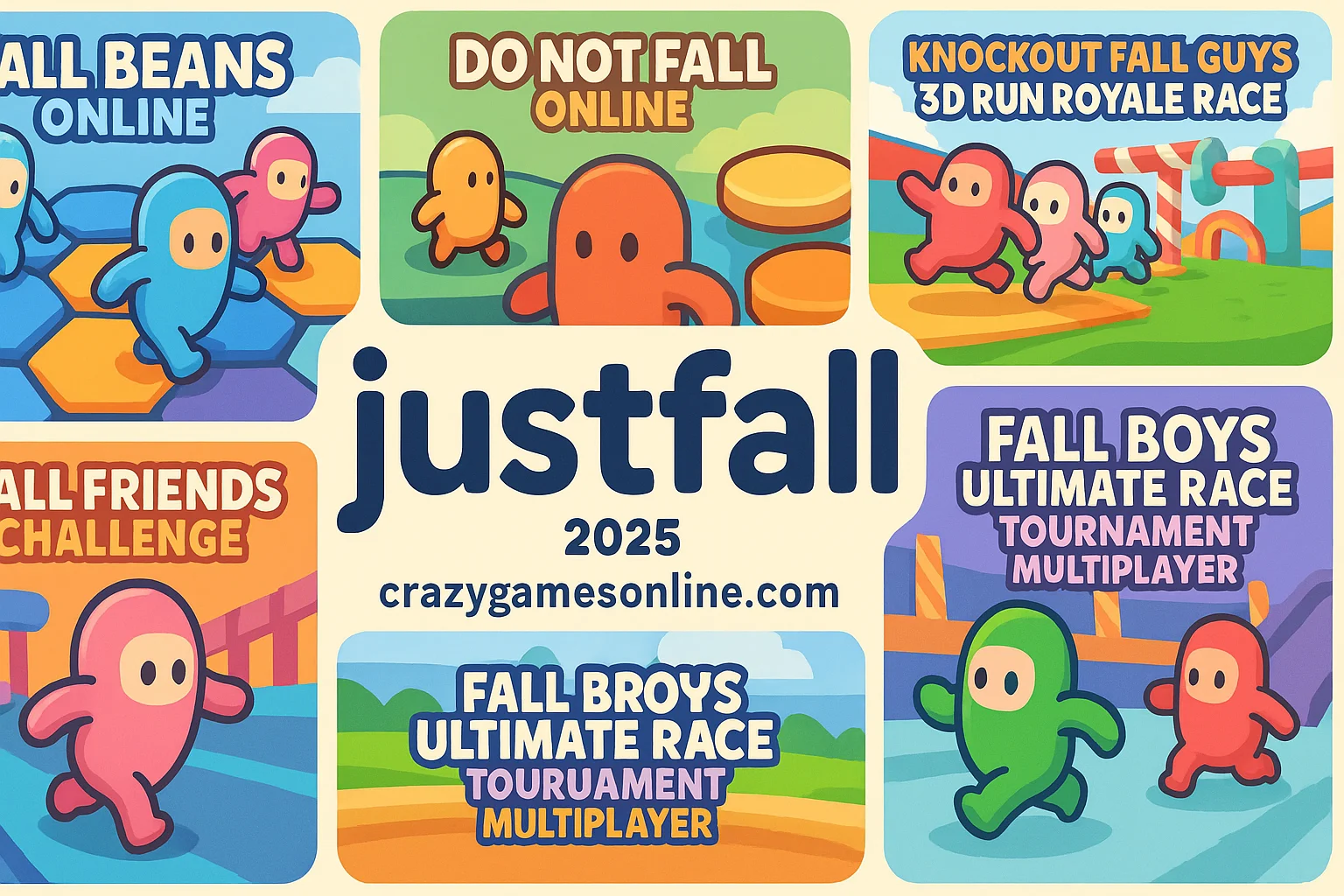
Fall Beans Online
If you want the same high-tempo tile economy with slightly floatier jumps, this one’s your jam. Early rounds are generous, but finals punish greedy arcs, rewarding players who bank micro-hops and read collapse patterns. The visual language is loud—good for quick hazard scanning—and the learning curve feels fair even when lobbies sweat. Mid-match strategy is identical to justfall: route thicker islands, deny chase lines, and widen your camera when beams speed up. Expect more chaotic pile-ups at chokepoints, which is perfect practice for body-blocking discipline. For a quick browser run that sharpens your endgame nerves, slot in a few rounds of Fall Beans Online mid-session and then return to justfall warmed up and confident. You’ll feel the transfer immediately.
Do Not Fall Online
A leaner hex-collapse experience that dials up tile decay speed so decisions matter every second. The trick is tempo control: alternate between burst sprints and deliberate pauses to force pursuers into thin ice while you keep a thick exit path. Camera stays mid-high so you can spot intact clusters before committing. The physics are honest—no surprise bounces—so misplays are readable and fixable. Use this as a lab for route prediction and denial footwork; you’ll notice your justfall finals stabilizing after a few runs. When mid-lobby chaos hits, breathe, pan, and re-route. Slide a practice block into Do Not Fall Online and you’ll come back sharper, calmer, and way harder to grief.
Knockout Fall Guys 3D Run Royale Race
This variant leans into obstacle variety—rotations, conveyors, pop-up bumpers—so your adaptability gets tested hard. Your plan: scan the first three hazards, commit to a side, and avoid center chaos unless you’re intentionally body-blocking. Timing traps are everywhere; the smartest play is often a half-second wait that buys a clean lane. Treat it as movement jazz—improvise routes while staying in rhythm. Mid-round, practice “tempo resets”: stop, breathe, camera sweep, re-accelerate. These reps translate directly to clutch moments in justfall. When you crave a busier course that still pays off clean inputs, queue Knockout Fall Guys 3D Run Royale Race and let the chaos refine your reads.
Fall Friends Challenge
Think of this as fundamentals bootcamp. Hazards are readable, jumps are crisp, and mistakes teach fast. Your job is to stack consistency habits: hold a preferred camera angle, route edges only when you have an exit, and never jump on auto-pilot. Use the calmer pacing to practice denial paths—cut behind you diagonally to maroon chasers without over-committing. The finals reward patience more than flair; the player who wastes fewer tiles wins. Run a block of Fall Friends Challenge when you feel sloppy, then swap back to justfall for higher-speed lobbies with steadier hands and cooler decisions.
Fall Boys Ultimate Race Tournament Multiplayer
Bigger crowds, louder hazards, and longer rotations make this the “crowd survival” drill. Your aim is collision management: don’t fight center mass; flank, pass on the outside, and keep your momentum safe from random bumps. Learn to shoulder-check—tiny camera nudges to track griefers without losing your line. Late rounds emphasize spacing over hero plays; slow is smooth, smooth is fast. If you can keep a clean stride here, justfall’s finals will feel spacious. For scrim-style pressure that bulletproofs your route discipline, hop into Fall Boys Ultimate Race Tournament Multiplayer and bank those survival reps.