















"bartender game" — The Right Mix of Skill, Speed, and Vibes
“bartender game” is that perfect five-minute chaos: pour, mix, pray the glass doesn’t explode. You’re chasing that sweet spot between showmanship and science more flair than a cooking sim, more precision than a clicker. To ground it, the real-world skill here is bartending/mixology, and if you want a primer on the craft that inspired this whole sub-genre, peep this concise background on bartending for context. In the browser, the loop is simple: eyeball the pour, experiment with ratios, serve, and watch the customer react like a biochemical sensor with opinions. It’s not an FPS your “hitbox” is taste buds; your “TTK” is the seconds before they spit it back. You’re rewarded for memory and subtlety: which spirits stack, which mixers soften bite, which garnishes round edges. Fail states are loud (faceplants, explosions, gagging); success is quiet (a grin, a tip, a “perfect”). If you’re looking for a quick mastery chase that still lets you vibe, this is it. Want to play the classic right now? Launch Bartender: The Right Mix instantly in your browser and see how good your palate really is.
🎮 Deep Dive (Pure Gameplay) Core gameplay loop of bartender game
You’re balancing three meters: accuracy, creativity, and restraint. Step 1: read the prompt (customer mood/hint). Step 2: pour base spirit(s) with control mouse press/hold or tap timing is your whole skill ceiling. Step 3: balance with mixers, acids, sweets, and bitters. Step 4: finish with shake/stir/strain and a garnish. The loop is: hypothesize → pour → taste test (reaction) → iterate. Difficulty ramps via tighter timing windows, fussier recipes, and harsher penalties for overpour. Sessions are short 90 seconds to 3 minutes but the “one more try” pull is real because your last run is a free lesson. Win condition? Hit the flavor profile with minimal waste and keep the crowd happy. Economy is soft: you’re basically min-maxing precision (don’t overflow), memory (ratios), and risk (adding a wildcard ingredient). Rookie traps: holding pour too long, stacking high-ABV spirits, skipping ice, over-garnishing. Mid-skill breakthroughs: learning that bitterness can rescue sweetness, lemon can wake a flat build, and dilution is a weapon, not a crime. High-skill? Fast, micro-adjusted pours that hit target ABV without touching overflow.
❓ What Is bartender game? (For Gamers) A gamer’s definition
A bartender game is a micro-sim puzzler where you craft cocktails to spec under time pressure. Think WarioWare pacing with Cooking Mama precision. You’re not shooting or platforming; you’re taste-crafting with invisible stats: sweetness, acidity, bitterness, booze strength, and chill/dilution. Modes range from casual sandbox (freestyle, experiment) to objective chains (serve X perfect classics) to endurance bars (survive a rush). Scoring usually combines accuracy (hitting the hidden ratio), speed, and waste (don’t dump the bar). For beginners: start with two-ingredient builds, count seconds, and watch reaction tells. Advanced play splits into macro (menu planning, flow efficiency) and micro (¼-second pour taps, corrective dashes). There’s no “map” here; your arena is the backbar. Power-ups translate to better tools (measuring jigger cues, clearer UI), while cooldowns are shaker/strain animations that punish panic. Controller vs KBM? Mouse has finer control; gamepad is comfy but demands tuned deadzones. Popular because it’s low friction, high expression, and every mistake is funny until it nukes your streak.
🧩 Features & Systems UI/HUD customization in bartender game
Good bartender games live or die by readability. You want: distinct bottle silhouettes, legible labels, and an input HUD that shows live pour time, estimated ml, and taste bias (sweet/sour/bitter) drifting as you mix. The best builds let you toggle pour guides (subtle hash marks), swap measurement units, and enable colorblind-safe ingredient tints. Audio is clutch: bottle glugs signal flow rate, the shaker’s pitch hints at dilution, glass clinks confirm strain timing. Accessibility toggles should include: reduced motion (for shake animations), larger labels, high-contrast bottle shelving, and slower pour modes for motor comfort. Replays aren’t about spectating opponents; they’re for reviewing your ratio errors was it 3.1 seconds instead of 2.6? Netcode/tick rate talk doesn’t really apply, but input latency does: browsers at 120–240 Hz feel noticeably better for micro-taps than 60 Hz. If the game offers practice mode with visible flavor meters, use it to map every ingredient’s impact so you can free-pour confidently during rushes.
🛠️ Controls, Settings, Strategy Best keybinds & button maps for bartender game
Keep it simple: 1–9 for bottles on the quick shelf, Shift as a “fine-pour modifier” (halves flow), Space to shake/stir, R to reset glass, E to garnish, Q to dump. On controller, bind LT as fine-pour and keep bottles on the D-pad for muscle memory. Sensitivity: prioritize low-latency pointer control; in Chrome/Brave set your monitor to native refresh and disable frame caps for smoother pour stops. Strategy: pre-stage your next two bottles, count “one-one-thousand” for 1 sec ~ ≈ a small pour, and feather taps to micro-correct. Drill: 10 reps hitting a 2.5-second pour within ±0.1s, then add a lemon dash and bitters without over-correcting. Crosshair? Not a thing your “reticle” is the lip of the bottle over the glass rim. Tilt control: breathe, aim, pour, pause, taste, fix. Review VODs only to catch bad habits like over-compensating with syrup when acidity was the real hole.
🔓 Unblocked & Platforms Play bartender game online free (safe methods)
This genre shines in-browser: one click, zero installs. Most versions run fine on modest laptops; if frames dip, switch to windowed mode, close extra tabs, and enable hardware acceleration. For restricted networks (school/work), legit access ≠ sketchy mirrors. Use reputable portals; if you need approval, ask admins to whitelist just the play path. Session persistence is usually cookie-based; if you want progress to stick, avoid clearing site data. Controllers can work via native browser APIs connect first, then refresh so bindings register. Cloud play is overkill here, but it can bypass weak CPUs if your connection is stable. WebGL errors? Update GPU drivers, toggle ANGLE backend, or nuke incompatible extensions. If you just want the classic: launch Bartender: The Right Mix, hit play, and you’re mixing in seconds.
✅ Reasons to Play Why bartender game still slaps
Fast loops, loud feedback, and an absurdly high memory + finesse skill ceiling. You can hop in for a two-minute run or grind perfection for an hour. It’s easy to teach (“pour, balance, garnish”) but hard to master (free-pour timing, silent corrections, knowing when dilution saves you). It’s streamer-friendly every fail is content, every perfect serve is clip-worthy. Free-to-play implementations are fair: the real currency is consistency. It’s also a nice creative sandbox; once you internalize the big six taste levers, you start inventing your own “house specials.” Cross-device play is flexible mouse is king for micro taps, but a tuned controller can feel silky. If you’re bored of shooters and want a different kind of clutch one that lives in the milliseconds between glugs this is your lane.
🧭 How to Play bartender game (Step-By-Step) open, set, pour
-
Open the game and check input latency by doing three micro-taps; if the stream stutters, reload in a fresh tab. 2) Set binds: fine-pour on Shift/LT, dump on Q/☰. 3) Start with a simple spec (e.g., 2 parts base, 1 part sour, 1 part sweet). 4) Count your pours use an internal metronome. 5) Correct with acid before sweet; bitterness is for over-sweet saves, not first aid. 6) Shake just long enough to chill (listen for the pitch drop), then strain. 7) Garnish minimally. 8) Watch the customer’s read if they grimace, identify which axis you overshot. 9) Iterate. 10) When consistent, push speed without losing accuracy. Post-match: jot your winning ratios so you can free-pour on instinct next run.
🍹 Similar Games to bartender game
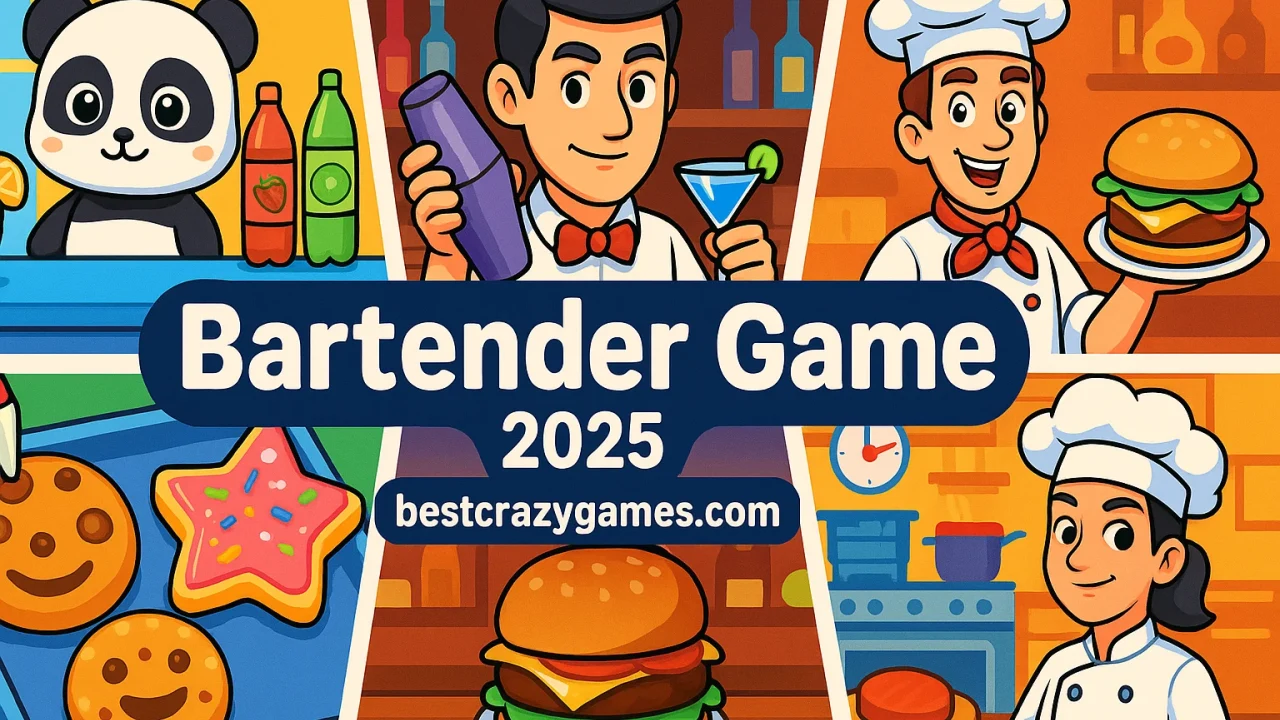
Baby Panda Drink Bar chill serving with cute chaos
This one leans hard into beverage crafting with a softer difficulty curve, perfect for warming up your pour rhythm. You’ll prep juices, layer smoothies, and match kid-friendly orders under mild time pressure; the trick is learning color/ingredient combos that pop without over-sweetening. Mid-run, it starts stacking multi-step recipes that force you to stage garnishes early so you don’t choke the finish. It’s adorable, but still punishes sloppy timing syrup floods end runs fast. For a no-stress “dial in the glug” session, try Baby Panda Drink Bar right in your browser and practice micro-taps before you tackle harder cocktails.
Crazy Cookies: Match ’n Mix patterning meets kitchen hustle
Not strictly cocktails, but the “mix to spec under a timer” DNA is the same. You’re juggling patterns, ingredients, and bake times; it rewards the exact mental stack bartender players need: short-term memory, queue management, and risk control. The late-game asks you to set up chains while preventing overbakes translating directly to “pour now, correct later” instincts. If you like the cognitive load of simultaneous tasks, hop into Crazy Cookies Match N Mix to sharpen sequencing before returning to the bar.
Cooking Fever: Happy Chef service-rush fundamentals
Here the fun is throughput: reading orders, prioritizing stations, and avoiding plate deadlocks. That mirrors bartending’s peak rush perfectly get base prep started, finish garnishes while the main is cooking/chilling, and deliver hot (or cold) on the dot. The pacing curve ramps cleanly, so you can feel your APM and route-planning improve. When you manage three tasks without panic, bartender games suddenly feel slower and easier. Load Cooking Fever Happy Chef mid-session to practice service flow and come back with better throughput.
Cooking Madness ratio discipline under speed
This one punishes over-clicking and rewards clean sequences. You’ll internalize “prep → assemble → deliver” loops and learn to stage inputs so you never idle while timers tick. That discipline is exactly what stops overpours back at the bar. It’s also great for tilt control: even when customers stack up, steady hands win. If your bartender runs implode when the room gets loud, do reps in Cooking Madness and train your calm.
Cooking Burger Maker Chef garnish timing and assembly order
Assembly games are underrated bartender coaches: sauce before greens, cheese before lid, garnish last tiny rules that mirror citrus before bitters, ice before shake, zest at finish. Miss the order and the dish (or drink) flops despite good ingredients. The midgame teaches you to batch without losing freshness, which maps to batching base pours across multiple glasses. Sharpen that sequencing muscle in Cooking Burger Maker Chef and your cocktail flow will feel way smoother.